Showing posts with label Charles Lindbergh. Show all posts

The "watcher" inside: journey into the self

We return today to Charles Lindbergh’s insightful exploration of the inner self. He made some interesting observations as he was flying over the Atlantic one night in May, 1927, on his way to becoming the first person to fly solo from New York to Paris.

Like other adventurers before him, Lindbergh seemed to be as much an explorer of inner landscapes as he was of the outside world. As one reads the account, an interesting question comes into focus: does fatigue break down the mind-body distinction and give us new insight into other components of our being?

Here, in his own words, are Lindbergh’s notes from the 18th hour of his flight:

“Shaking my body and stamping my feet no longer has effect. It’s more fatiguing than arousing. I’ll have to try something else. I push the stick forward and dive down into a high ridge of cloud, pulling up sharply after I clip through its summit. That wakes me a little, but tricks don’t help for long. They’re only tiring. It’s better to sit still and conserve strength.

“My mind strays from the cockpit and returns. My eyes close, and open, and close again. But I’m beginning to understand vaguely a new factor which has come to my assistance. It seems I’m made up of three personalities, three elements, each partly dependent and partly independent of the others. There’s my body, which knows definitely that what it wants most in the world is sleep. There’s my mind, constantly making decisions that my body refuses to comply with, but which itself is weakening in resolution. And there’s something else, which seems to become stronger instead of weaker with fatigue, an element of spirit, a directive force that has stepped out from the background and taken control of both mind and body. It seems to guard them as a wise father guards his children; letting them venture to the point of danger, then calling them back, guiding with a firm but tolerant hand.

“When my body cries out that it must sleep, this third element replies that it may get what rest it can from relaxation, but that sleep is not to be had. When my mind demands that my body stay alert and awake, it is informed that alertness is too much to expect under these circumstances. And when it argues excitedly that to sleep would be to fail, and crash, and drown in the ocean, it is calmly reassured, and told it’s right, but that while it must not expect alertness on the body’s part, it can be confident there’ll be no sleep.

“My eyes, under their weighted lids, seem completely disconnect from my body, to have within themselves no substance, to be conscious rather than to see. They become a part of this third element, this separate mind which is mine and yet is not, this mind both far away in eternity and within the confines of my skull, within the cockpit and outside of it at the same moment, connected to me and yet unlimited to any finite space.

“During long ages between dawn and sunrise, I’m thankful we didn’t make The Spirit of St. Louis a stable plane. The very instability which makes it difficult to fly blind or hold an accurate course at night now guards me against excessive errors. It’s again a case of the plane and me compensating for each other…”


Notes:
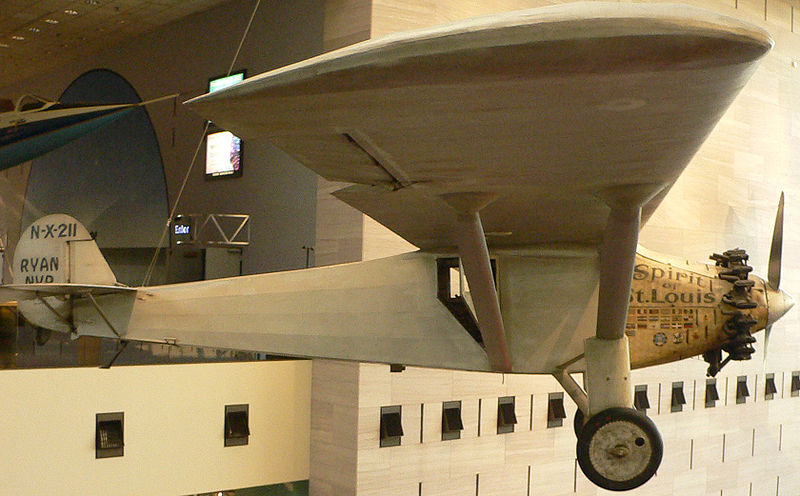
1. Photograph of The Spirit of St. Louis in the Smithsonian Air and Space Museum is courtesy of Wikimedia Commons (Public Domain), under the terms of the GNU Free Documentation License
2. Book excerpt: The Spirit of St. Louis, by Charles Lindbergh, 1953, Charles Scribner's and Sons, New York, pages 361-362 (1956 edition).

-------------
> To send this to a friend, click on the envelope icon.

Mind journeys: Charles Lindbergh's experience

Readers of this blog will know from previous posts about my interest in the relationship between the mind, the body and the world.

Charles Lindbergh, the first man to fly alone across the Atlantic from New York to Paris, described some interesting aspects of the mind-body connection. Sleep-deprived and totally dependent on the reliability of his single-engined plane, Lindbergh experienced phenomena on the long flight which suggest we have mental capacities which we barely understand.

I'd like to share an excerpt from his account of that voyage in 1927.

It's night. He's been in the air for 17 hours of the 33 it will eventually take him to arrive in Paris. He's flying a few hundred feet above the ocean and clouds. He writes:

"On a long flight, after periods of crisis and many hours of fatigue, mind and body become disunited until at times they seem completely different elements, as though the body were only a home with which the mind has been associated but by no means bound. Consciousness becomes independent of the ordinary senses. You see without assistance from the eyes, over distances beyond the visual horizon. There are moments when existence appears independent even of the mind. The importance of physical desire and immediate surroundings is submerged in the apprehension of universal values.

"For immeasurable periods, I seem divorced from my body, as though I were an awareness spreading out through space, over the earth and into the heavens, unhampered by time or substance, free from the gravitation that binds men to heavy human problems of the world. My body requires no attention. It's not hungry. It's neither warm nor cold. It's resigned to being left undisturbed. Why have I troubled to bring it here? I might better have left it back at Long Island or St. Louis, while this weightless element that has lived within it flashes through the skies and views the planet. This essential consciousness needs no body for its travels. It needs no plane, no engine, no instruments, only the release from flesh which the circumstances I've gone through make possible.

"Then what am I -- the body substance which I can see with my eyes and feel with my hands? Or am I this realization, this greater understanding which dwells within it, yet expands through the universe outside; a part of all existence, powerless but without need for power; immersed in solitude, yet in contact with all creation? There are moments when the two appear inseparable, and others when they could be cut apart by the merest flash of light.

"While my hand is on the stick, my feet on the rudder, and my eyes on the compass, this consciousness, like a winged messenger, goes out to visit the waves below, testing the warmth of the water, the speed of wind, the thickness of intervening clouds. It goes north to the glacial coasts of Greenland, over the horizon to the edge of dawn, ahead to Ireland, England, and the continent of Europe, away through space to the moon and stars, always returning, unwillingly, to the mortal duty of seeing that limbs and muscles have attended their routine while it was gone."

Was Lindbergh hallucinating, or did he experience a deeper level of existence which opened for him through his state of exhaustion? His words echo those of many other people who have gone through traumatic situations and been able to talk about them.

In the days ahead, I'll post another excerpt. In it, Lindbergh describes his growing awareness of a third, watchful element in his being.

For a related post, see "The astounding power of the brain" from July 1st.

Notes:
1. Lindbergh photo courtesy of Wikimedia Commons (Public Domain)
2. Book excerpt: The Spirit of St. Louis, by Charles Lindbergh, 1953, Charles Scribner's and Sons, New York, pages 352-353 (1956 edition).

Weekend reading - Lindbergh's story still captures the imagination

This is my drawing of Charles Lindbergh and "The Spirit of St. Louis," the plane he flew alone across the Atlantic in May, 1927.

The story of the first solo air crossing from New York to Paris in thirty-three-and-a-half hours is a fascinating one. Charles Lindbergh was an obscure 25-year-old mail pilot from St. Louis at the time. The thought of attempting the crossing came to him late one moonlit night as he was flying to Chicago in his open-cockpit DeHavilland biplane in 1926. He faced an uphill climb. Aviation companies and plane manufacturers did not know him. He had very little money and no experience navigating oceans. And yet, he was able to convince local businessmen in St. Louis to finance his project, was able to find a company in San Diego to build him a plane and taught himself everything he needed to know to fly by compass and dead reckoning alone across the ocean.

Others had died attempting the crossing before him, but Lindbergh worked out his plan and stuck with it, even as others criticized him for it. Many people, for example, believed a multi-engine plane was necessary for a trans-Atlantic crossing; but Lindbergh, a former barnstormer who was keenly aware of engine reliability in the 1920s, felt the more engines on an aircraft, the more chances of failure. He instead placed his confidence in a single Wright Whirlwind engine and focused on adding fuel capacity to his plane. Trusting his abilities to stay alert for long periods of time and on his painstaking navigational calculations, he limited himself to loading the plane only with fuel and the most basic emergency gear, some drinking water and four sandwiches. Saving weight and improving fuel efficiency was his ticket to survival.

"Spirit of St. Louis," the book

I'm reading all about this in Lindbergh's own words, as he set them down in his 1953 book which carries the same title as the name of his plane.

It's one of the best books I've picked up in years (thanks, Quentin Payette). Many accounts of historical exploits tend to reflect the terminology of the day and appear archaic, even musty. Not so with Lindbergh's story. It sounds like he's recording a podcast or posting a weblog. His writing has a very modern quality to it. He seems the type of person who could easily switch centuries and appear before us as a jet pilot or an engineer with a laptop. Comfortable and confident in his own skin, his Midwestern humility and down-to-earth sensibilities helped him achieve history in the skies. He wrote the book in the present tense, so we feel we're taking the journey with him, moment-by-moment. The book is a surprising page-turner. And it won the 1954 Pulizter Prize for biography .

For more information on the record-breaking flight see this page from the site devoted exclusively to Lindbergh.

Other links:
The plane: see this "Spirit of St. Louis" page and the Wikipedia page
The book: Link to on-line supplier Chapters.Indigo.ca
-------------
To send this to a friend, click on the envelope icon.