Showing posts with label mind. Show all posts

Despite today's travel hassles, a trip still offers self-renewal and new possibilities

One of the benefits of travel, whether near or far, is the prospect of renewal. Besides getting from point A to point B, travel offers unique opportunities for seeing life a little differently. Once on a plane, train, ship, bus or automobile, for example, the traveller becomes a sort of willing prisoner. While some passengers turn to amusements to pass the time, others find the act of travel opens the mind to fresh perspectives. It's like being in suspended animation. On a long trip, one may become melancholy, thinking about the past, reflecting on loneliness and failures; but at other times, ideas flow like a waterfall with new resolutions, plans for the future, and ambitions. Travel can be as much about measuring oneself as it is about physically getting to a new destination.

Not everyone, however, sees it the same way. John Steinbeck, winner of the Nobel prize for literature, in his narrative about a trip around the Baja Peninsula in 1941 (The Log from The Sea of Cortez), appears to take the view that people do not escape themselves, no matter how much they long to travel. Describing the scene on the departure from the port of San Diego, Steinbeck writes:

"Strangers came to the pier and stared at us and small boys dropped on our decks like monkeys. Those quiet men who always stand on piers asked where we were going and when we said, 'To the Gulf of California,' their eyes melted with longing, they wanted to go so badly. They were like the men and women who stand about airports and railroad stations; they want to go away, and most of all they want to go away from themselves. For they do not know that they would carry their globes of boredom with them wherever they went. One man on the pier who wanted to participate made sure he would be allowed to cast us off, and he waited at the bow line for a long time. Finally he got the call and he cast off the bow line and ran back and cast off the stern line; then he stood and watched us pull away and he wanted very badly to go."

I admire the detail in the scene, but I respectfully disagree with the great Steinbeck. While I think it's true that travel is often simply a temporary diversion from our daily problems, I don't think a trip leaves us unchanged: those of us who may be carrying around those "globes of boredom" can free ourselves of them.

On a flight to Toronto, I find communion with Timothy Taylor's thoughts on the subject in Air Canada's enRoute magazine. Taylor has written a series of travel articles called "The New Simplicity." He opens one of them like this:

"In travel, while you don't want to rush, moments of real speed can be exhilarating. I mean those times during a trip when you can feel the globe rotating under your feet, the landscape transforming before your eyes. Liftoff out of Vancouver, on a trans-Pacific flight, is particularly evocative of this sensation for me. The ground melts away behind, the scenery blurring and morphing. The sea opens up under the wheels, and there is a sudden sense of transference, of life moving from the known to the possible. And when the landing gear folds home, with that light but comforting thud, a point is sealed: We're all in transit, in physical suspension, mid-teleportation. When the flight is over - I feel this every time, with a sudden and intense certainty - a new world of unpredictable possibilities will begin to make itself known."

Taylor finds this experience is not limited to planes. Describing the high-speed trains in Japan, he makes this observation: "... the trains here often feel less like a linear mechanical system and more like a quantum one, a series of black holes sucking people out of one reality and releasing them some distance away in the midst of another."

Back when travel was more of an "occasion," before the days of x-ray machines, line-ups, and general cattle-herding, a voyage was much more likely to offer moments of authentic conversation, fresh perspectives and even zen-like clarity.

And yet, despite all the modern-day hassles, remarkably, it still does. All that is required on our part is a little awareness and letting go of the shackles of the mind, even only for a minute or two. It's well worth it.

Travel and change of place impart new vigor to the mind. ~Seneca

---------------
Links:

1. Description of the Log from the Sea of Cortez.
2. enRoute magazine. "Eastern Promises. The New Simplicity, part three: Betting on Buddha," by Timothy Taylor.
3. Taylor's website is here.

The "watcher" inside: journey into the self

We return today to Charles Lindbergh’s insightful exploration of the inner self. He made some interesting observations as he was flying over the Atlantic one night in May, 1927, on his way to becoming the first person to fly solo from New York to Paris.

Like other adventurers before him, Lindbergh seemed to be as much an explorer of inner landscapes as he was of the outside world. As one reads the account, an interesting question comes into focus: does fatigue break down the mind-body distinction and give us new insight into other components of our being?

Here, in his own words, are Lindbergh’s notes from the 18th hour of his flight:

“Shaking my body and stamping my feet no longer has effect. It’s more fatiguing than arousing. I’ll have to try something else. I push the stick forward and dive down into a high ridge of cloud, pulling up sharply after I clip through its summit. That wakes me a little, but tricks don’t help for long. They’re only tiring. It’s better to sit still and conserve strength.

“My mind strays from the cockpit and returns. My eyes close, and open, and close again. But I’m beginning to understand vaguely a new factor which has come to my assistance. It seems I’m made up of three personalities, three elements, each partly dependent and partly independent of the others. There’s my body, which knows definitely that what it wants most in the world is sleep. There’s my mind, constantly making decisions that my body refuses to comply with, but which itself is weakening in resolution. And there’s something else, which seems to become stronger instead of weaker with fatigue, an element of spirit, a directive force that has stepped out from the background and taken control of both mind and body. It seems to guard them as a wise father guards his children; letting them venture to the point of danger, then calling them back, guiding with a firm but tolerant hand.

“When my body cries out that it must sleep, this third element replies that it may get what rest it can from relaxation, but that sleep is not to be had. When my mind demands that my body stay alert and awake, it is informed that alertness is too much to expect under these circumstances. And when it argues excitedly that to sleep would be to fail, and crash, and drown in the ocean, it is calmly reassured, and told it’s right, but that while it must not expect alertness on the body’s part, it can be confident there’ll be no sleep.

“My eyes, under their weighted lids, seem completely disconnect from my body, to have within themselves no substance, to be conscious rather than to see. They become a part of this third element, this separate mind which is mine and yet is not, this mind both far away in eternity and within the confines of my skull, within the cockpit and outside of it at the same moment, connected to me and yet unlimited to any finite space.

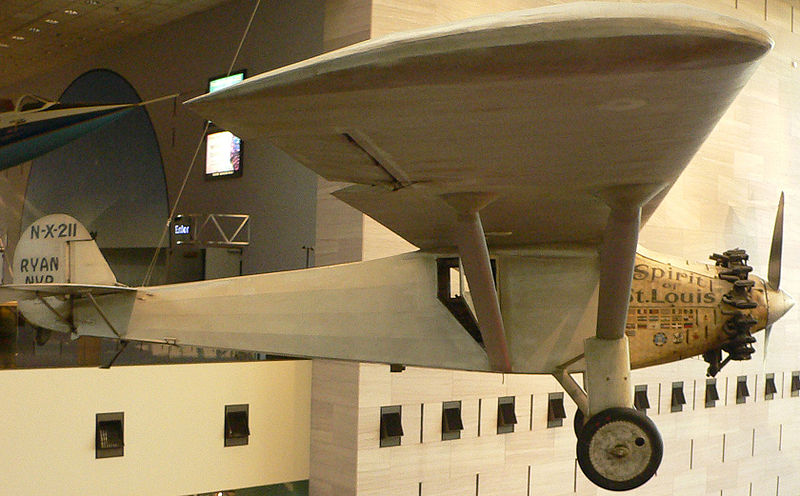
“During long ages between dawn and sunrise, I’m thankful we didn’t make The Spirit of St. Louis a stable plane. The very instability which makes it difficult to fly blind or hold an accurate course at night now guards me against excessive errors. It’s again a case of the plane and me compensating for each other…”


Notes:
1. Photograph of The Spirit of St. Louis in the Smithsonian Air and Space Museum is courtesy of Wikimedia Commons (Public Domain), under the terms of the GNU Free Documentation License
2. Book excerpt: The Spirit of St. Louis, by Charles Lindbergh, 1953, Charles Scribner's and Sons, New York, pages 361-362 (1956 edition).

-------------
> To send this to a friend, click on the envelope icon.

Mind journeys: Charles Lindbergh's experience

Readers of this blog will know from previous posts about my interest in the relationship between the mind, the body and the world.

Charles Lindbergh, the first man to fly alone across the Atlantic from New York to Paris, described some interesting aspects of the mind-body connection. Sleep-deprived and totally dependent on the reliability of his single-engined plane, Lindbergh experienced phenomena on the long flight which suggest we have mental capacities which we barely understand.

I'd like to share an excerpt from his account of that voyage in 1927.

It's night. He's been in the air for 17 hours of the 33 it will eventually take him to arrive in Paris. He's flying a few hundred feet above the ocean and clouds. He writes:

"On a long flight, after periods of crisis and many hours of fatigue, mind and body become disunited until at times they seem completely different elements, as though the body were only a home with which the mind has been associated but by no means bound. Consciousness becomes independent of the ordinary senses. You see without assistance from the eyes, over distances beyond the visual horizon. There are moments when existence appears independent even of the mind. The importance of physical desire and immediate surroundings is submerged in the apprehension of universal values.

"For immeasurable periods, I seem divorced from my body, as though I were an awareness spreading out through space, over the earth and into the heavens, unhampered by time or substance, free from the gravitation that binds men to heavy human problems of the world. My body requires no attention. It's not hungry. It's neither warm nor cold. It's resigned to being left undisturbed. Why have I troubled to bring it here? I might better have left it back at Long Island or St. Louis, while this weightless element that has lived within it flashes through the skies and views the planet. This essential consciousness needs no body for its travels. It needs no plane, no engine, no instruments, only the release from flesh which the circumstances I've gone through make possible.

"Then what am I -- the body substance which I can see with my eyes and feel with my hands? Or am I this realization, this greater understanding which dwells within it, yet expands through the universe outside; a part of all existence, powerless but without need for power; immersed in solitude, yet in contact with all creation? There are moments when the two appear inseparable, and others when they could be cut apart by the merest flash of light.

"While my hand is on the stick, my feet on the rudder, and my eyes on the compass, this consciousness, like a winged messenger, goes out to visit the waves below, testing the warmth of the water, the speed of wind, the thickness of intervening clouds. It goes north to the glacial coasts of Greenland, over the horizon to the edge of dawn, ahead to Ireland, England, and the continent of Europe, away through space to the moon and stars, always returning, unwillingly, to the mortal duty of seeing that limbs and muscles have attended their routine while it was gone."

Was Lindbergh hallucinating, or did he experience a deeper level of existence which opened for him through his state of exhaustion? His words echo those of many other people who have gone through traumatic situations and been able to talk about them.

In the days ahead, I'll post another excerpt. In it, Lindbergh describes his growing awareness of a third, watchful element in his being.

For a related post, see "The astounding power of the brain" from July 1st.

Notes:
1. Lindbergh photo courtesy of Wikimedia Commons (Public Domain)
2. Book excerpt: The Spirit of St. Louis, by Charles Lindbergh, 1953, Charles Scribner's and Sons, New York, pages 352-353 (1956 edition).

How to foster creativity

Let's take a minute to explore creativity.

If you feel like you're in a rut and can't "think out of the box," then go some place you've never been before.

New evidence suggests that creativity flourishes most when we place ourselves in situations we've never experienced. New faces, new places, new thinking.

Why is this? Researchers say the brain's natural tendency is to be somewhat lazy. The mind prefers to take shortcuts and rely on established images and ways of seeing things. To jolt the brain into creative mode, it apparently helps to jump into something you have absolutely no experience with. Take away the "safety net," break your historical mental connections and see what happens.

In an article entitled "Neuroscience Sheds New Light on Creativity," FastCompany.com reveals that when it comes to seeing things differently, Mark Twain may have been right when he said, "Education consists mainly in what I have unlearned." When the brain confronts different situations, it reorganizes perception. It pays more attention to all of the senses. It lives in the moment. The more radical the experience, the greater the chances of acquiring new perception.

If scientists are right, then what a wonderful supporting argument this makes for the benefits of travel and for changing the scenery once in a while.

Just remember to bring a pen and paper with you. You may find solutions to your problems when you least expect them -- on the top of a pyramid, learning to ski or on a hike in the woods.

Willlam James:

"Genius means little more than the faculty of perceiving in an unhabitual way."

Albert Einstein:

"You can never solve a problem on the level on which it was created."

....and my favourite....

Buckminster Fuller:

"There is nothing in a caterpillar that tells you it's going to be a butterfly."

Yes, indeed.

Other links:

Ten Steps for Boosting Your Creativity

The Astounding Power of the Brain

Take a 5-minute test to compare your Right Brain vs Left Brain Creativity (from the Art Institute of Vancouver).

Photo credit: Thanks to Robert Russell for his shot of a Florida sunrise.

-------------

> To send this to a friend, click on the envelope icon.